
Additional warnings against technological “progress”

Should we be fearful for rapid technological progress? An increasing number of experts and thinktanks say we should.
By now, warnings continue to come our way. Whether from thinktanks or university-expert collaboration projects. Even tech company CEO’s want to point out the dangers of technology. Let us make a small selection of warnings that have come our way early 2018.
There’s always the question how much technology is empowering a small group of people to cause damage (Bill Gates, 2018)
The UK has given a clear signal in the direction of major tech, as lawmakers believe that there is a necessity to stop their monopolies. We cite: An influential body of UK policymakers said regulators should stop major tech companies from dominating the field of artificial intelligence, and also warned on the potential of widespread unemployment due the technology. Large companies which have control over vast quantities of data must be prevented from becoming overly powerful within this landscape.
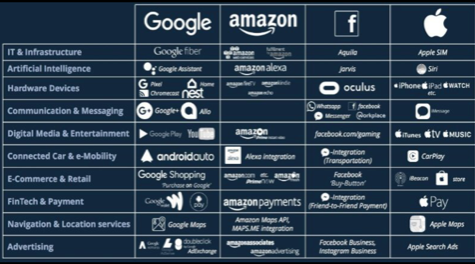
British politics is becoming aware of the reality of technological dominance by a few big players that are active in every branch of technological applications, as shown in the picture below.
I don’t have a kid, but I have a nephew that I put some boundaries on. “There are some things that I won’t allow; I don’t want them on a social network. (Tim Cook (Apple), 2018)
In a recent research report, 26 experts from 14 different institutions warn us about the rise and impact of artificial intelligence. In their report, “The malicious use of Artificial Intelligence”, the experts warn of a so-called “Dual Technology”. They “expect the growing use of AI systems to lead to the expansion of existing threats, the introduction of new threats and a change to the typical character of threats.”
The experts believe that researchers and scientists should spend much greater effort into thinking about the negative implications of the technologies that they involve themselves with. Tech companies should do the same.
We do not have long to act. Once this Pandora’s box is opened, it will be hard to close (Elon Musk en Alphabet’s Mustafa Suleyman are leading a group of 116 specialists from across 26 countries, 2017)
Experts from the centre for existential risk, in Cambridge, warn about political instability and the demise of democracy. Increasingly, technology has the capacity for politically disruptive impact. “We live in a world that could become fraught with day-to-day hazards from the misuse of AI and we need to take ownership of the problems – because the risks are real. There are choices that we need to make now, and our report is a call-to-action for governments, institutions and individuals across the globe.
Google co-founder Sergey Brin recently wrote a letter wherein he put to words his concerns about the future of technology. Not only job loss, but manipulative action by means of tech and artificial intelligence were among his concerns. Luckily, these are mere dangers and not inevitable outcomes: “While I am optimistic about the potential to bring technology to bear on the greatest problems in the world, we are on a path that we must tread with deep responsibility, care, and humility.”
And that is how it is!
No wonder this is how Google’s Alphabeth’s “founders letter” began:
It was the best of times,
it was the worst of times,
it was the age of wisdom,
it was the age of foolishness,
it was the epoch of belief,
it was the epoch of incredulity,
it was the season of Light,
it was the season of Darkness,
it was the spring of hope,
it was the winter of despair ...” (from Dickens, A Tale of two cities)
Even though there are many doomsayers, we fortunately also find other stories to listen to. We see a steep rise in fear for artificial intelligence and robotics, but we also hear voices that push back against such fears. Dmitri Alperovitch, co-founder of information security firm CrowdStrike, is one of those people who push back against stories of inevitable doom: “I am not of the view that the sky is going to come down and the earth open up. There are going to be improvements on both sides; this is an ongoing arms race. AI is going to be extremely beneficial, and already is, to the field of cybersecurity. It’s also going to be beneficial to criminals. It remains to be seen which side is going to benefit from it more.”
As a trend and future intelligence company, we do not merely look at the positive faces of technology, but also at the trends that would counter its bright future. Obviously. We see an increasing awareness of the dangers of technology, but believe that in the end the better part of our humanity will prevail. We talk with corporations, governments and other organizations and emphasize the importance of taking responsibility for individual and organizational action. What is the nature and purpose of the use of technology by organizations? Can the purposes of their technologies be realigned with more purposeful applications? We can find real added value for technology when tech is purposed for the benefit of society.
More information about the positive and negative sides of technology? Book a session with met topfuturist Tony Bosma and translate these insights to your own organization. Contact Extend Limits.

