

Our infrastructure is an important source of our happiness and also has a significant impact on the environment. Therefore,innovation in physical infrastructure have a profound impact the human happiness.
Infrastructure will last for years, decades. Therefore it is important to think ahead when it comes down to infrastructure. A future where technology will play an increasingly important role for our buildings. A future in which we as humans can no more evade our planet. A future in which buildings and infrastructure are increasingly getting flexible. Buildings are no longer rigid but can be transformed with the variable requirement of the human being. A future in which the health of the planet and people are most important. A wonderful future? In any case, a future with plenty of challenges. These challenges are already being picked up nowadays. Essential given the enormous impact of our infrastructure for us as human beings.
We listed a few recent inspiring examples.
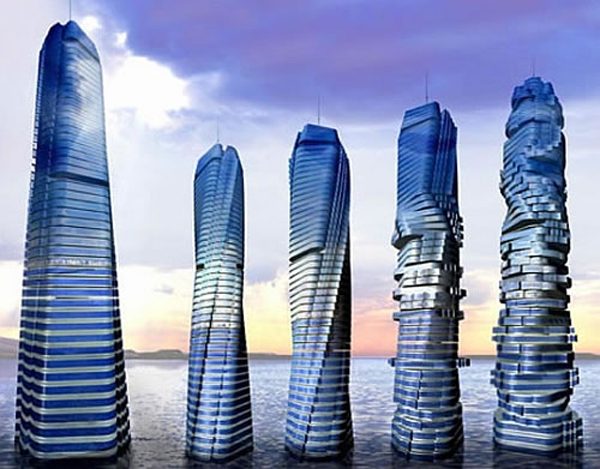
The rotating tower in Dubai
Dubai can do anything. Plans are now very practical to start with the construction of a rotating tower. It is a skyscraper that generates both sun and wind. It can also fully rotate. The plan of the tower was already presented in 2008 but now the actual realization starts. Between all levels, wind turbines will be installed that can generate electricity. Of course there are also solar facades included. The tower must generate as much as renewable energy as consumed. The excess energy generated goes also to other buildings. In 2020 the tower will be reality.
Forest city in China
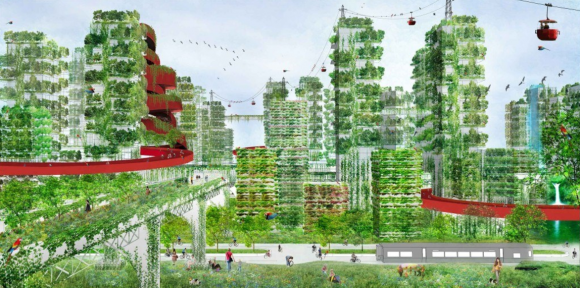
An entire city where every building grows trees, shrubs and plants. Everything to adsorb and improve air quality for people. This is the idea of the Italian architect Stefano Boeri for the Chinese city of Shijiazhuang. The idea: create the first “Forest City”. Who would not want to live there. A clear example of the trend towards sustainability and greening of our environment. The first “Forest City” should be an example for all Chinese cities. an example in which there is room for urban agriculture and nature. The ultimate goal is to also avoid the necessary distribution of food within a city so that we can relaunch local production. The idea is to create the first Forest City in 2020, whereas other cities will follow.
Brussel as the green city?
No new construction but reuse is the magic word of the future. We see it everywhere. In The Netherlands but also in Belgium. The idea is to transform the warehouse Thurn and Taxis into a combination of residential, business center and events venue. All around the idea of a green city. Belgian architect Vincent Callebaut has developed a master plan. Callebaut is a well-known architect and has also developed the lasting six residential towers in the Indian capital New Delhi.
The plan contains an area of 135,000 square meters. There will be three buildings placed that grows trees and plants. These vertical forests should eventually be 100 meters high. Everything is made from renewable materials. There is also room for a so-called eco-campus where work and relaxation comes together. Also again, a green sustainable environment. Energy is generated, shared and stored, if necessary.

Just a few examples of the world’s infrastructure that is fundamentally changing. The examples are hopeful in a world that cries out for change at every level.
More inspiring examples of the future of our infrastructure? contact Extend Limits for trend reports, inspiration session or advice